XAUUSD Spread Explained: The Hidden Cost That Decides Your EA's Results
TL;DR the XAUUSD spread is the gap between gold's bid (sell) and ask (buy) price — typically 10–35 cents on a good account, more on standard accounts. You pay it on every trade, it widens dramatically at rollover, in the Asian session and around news, and for a frequently-trading gold EA it's often the single biggest factor separating a profitable backtest from a losing live account.
What the spread actually is
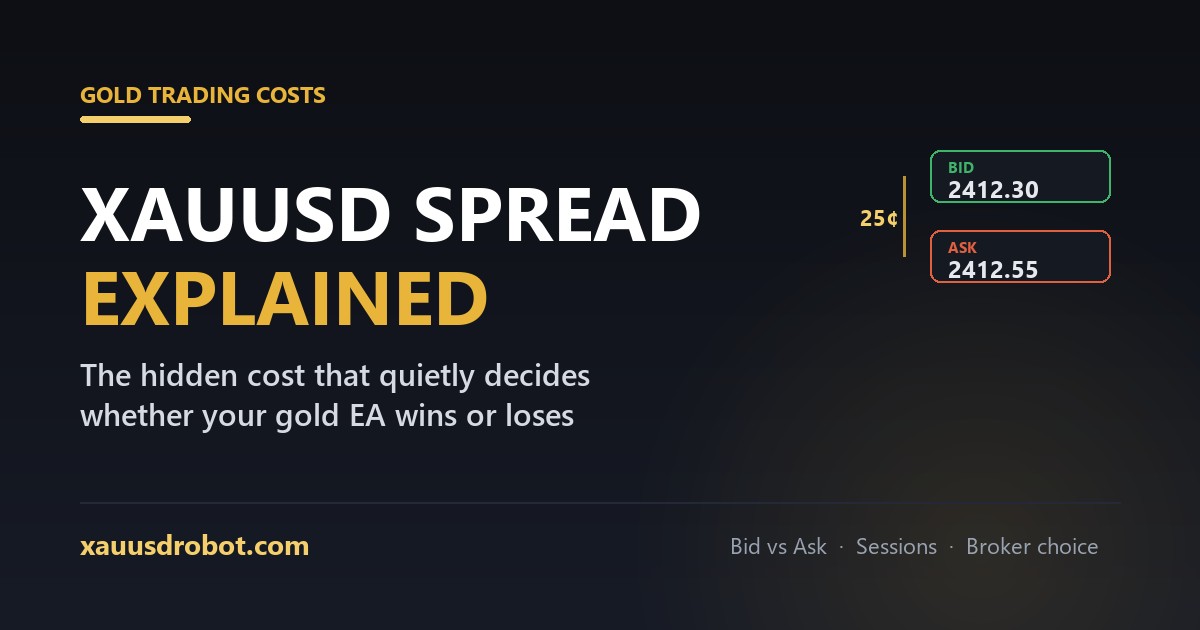
Every instrument has two prices at any moment: the bid (what buyers will pay you — where your sells and long-exits fill) and the ask (what sellers charge you — where your buys fill). The difference is the spread:
Bid 2412.30 / Ask 2412.55 → spread = $0.25 (25 cents)
The moment you open a position, you're down by the spread — a buy fills at the ask, but could only be closed instantly at the lower bid. That's not a fee your broker lists on a statement; it's baked into the fill prices. Which is exactly why it's the most under-counted cost in gold trading.
Why gold's spread is higher than forex
New traders coming from EURUSD are often shocked by gold's spread. Three structural reasons:
- Volatility. Gold moves several dollars in minutes when it's active. Market makers quoting both sides of that risk charge more for it.
- Fragmented liquidity. Gold trades across futures (COMEX), spot OTC and ETFs — the liquidity your broker taps is deep, but not as concentrated as a major currency pair.
- Session dependence. Real depth exists mainly during London and New York hours; outside them, fewer quotes = wider spreads. We mapped this in the best time to trade XAUUSD.
What it really costs you per trade
On XAUUSD, a $0.10 move is commonly counted as 1 pip (10 points). At 0.01 lots, each $0.10 of movement ≈ $0.10 of P&L — you can check any size instantly with our gold pip calculator. So:
| Spread | Cost at 0.01 lot | Cost at 0.10 lot | Cost at 1.00 lot |
|---|---|---|---|
| 20 cents | $0.20 | $2.00 | $20 |
| 35 cents | $0.35 | $3.50 | $35 |
| 50 cents | $0.50 | $5.00 | $50 |
Looks small — until you multiply. An EA taking 4 trades a day at 0.10 lots with a 35-cent spread pays ~$70/week in spread alone, win or lose. Over a year that's several thousand dollars of headwind on a modest account. The spread is a silent partner taking a cut of every single trade.
When the spread blows out (and why it matters)
| Period | What happens |
|---|---|
| Rollover (~21:00–23:00 GMT) | Liquidity providers reset; spreads can jump 3–10× for a while every single day |
| Asian session | Thinner books — persistently wider than London/NY hours |
| Sunday open | Weekend gap + thin liquidity = wide, jumpy quotes |
| News seconds (NFP, CPI, FOMC) | Spread can hit several dollars for a few minutes — covered in trading gold during news |
The nasty part: stops on long positions fill at the bid. When the spread blows out, the bid drops even if the "price" you see barely moved — and a tight stop-loss can be executed by the spread alone. This is why serious gold EAs restrict trading hours and avoid news windows, not because volatility is scary but because execution costs explode precisely then.
What spread does to an EA's edge
Think of an EA's edge as its average profit per trade before costs. Spread eats a fixed slice of that on every trade — so the smaller the target, the bigger the bite:
| Strategy style | Avg target | 35c spread eats | Verdict |
|---|---|---|---|
| Scalping | $1.00 | 35% of the target | Spread-critical — needs a raw account, tight hours |
| Intraday | $3.00 | ~12% | Significant — measure and manage it |
| Swing/trend | $10.00+ | ~3% | Tolerant — spread rarely the deciding factor |
This single table explains why our XAUUSD Scalping EA guide insists on low-spread accounts, while the flagship XAUUSD PRO — a slower trend-following system — is more forgiving of account type. It also explains a classic mystery: a backtest run at a fixed 20-cent spread can show profits that vanish live on a 45-cent account. Same EA, same logic — the spread was the difference. Always backtest with realistic spreads.
How to pay less spread
- Pick the right account type. Raw/ECN-style accounts charge ~10–25 cents + a fixed commission — usually cheaper overall than "zero-commission" standard accounts with 40–50 cent spreads. Our broker guide for gold EAs compares the options.
- Trade the deep hours. London–New York overlap has the tightest spreads of the day.
- Avoid rollover and news seconds. A time filter costs nothing and skips the worst execution of the day.
- Measure, don't trust. Advertised "from 0.0" spreads are minimums, not averages. Run the EA on demo and log the real average spread your broker delivers on XAUUSD.
- Size trades properly. Spread cost scales with lot size — our lot size calculator keeps sizing tied to risk, not hope.
Where our robot stands: the free XAUUSD Robot trades a trend-following style with meaningful profit targets, restricts trading to liquid hours and stands aside around major news — a design that keeps spread a manageable cost rather than the edge-killer it is for high-frequency systems. It runs best on the low-spread accounts of our partner brokers.
Get the Free Gold EA →Questions we get
What is the spread in XAUUSD trading?
The gap between bid (sell price) and ask (buy price) — e.g. 2412.30 / 2412.55 = 25 cents. Every trade starts down by this amount.
Why is the gold spread so high?
Higher volatility and more fragmented liquidity than major forex pairs — market makers charge more to quote gold's risk.
What is a good spread for XAUUSD?
Roughly 10–25 cents (+ commission) on a raw account during liquid hours; 30–50 cents is typical on standard accounts.
When is the spread widest?
Daily rollover (~21:00–23:00 GMT), the Asian session, Sunday open, and the seconds around NFP/CPI/FOMC — when it can hit several dollars.
How does spread affect a gold EA?
It takes a fixed bite of every trade's target. Scalping systems can lose their whole edge to it; slower trend systems are more tolerant.
Can spread widening hit my stop-loss?
Yes — long stops fill at the bid, and a blown-out spread drops the bid even without a real price move. News-time spreads take out tight stops on their own.
How do I pay less spread?
Raw account type, liquid hours, avoid rollover/news, measure your broker's real average, size positions by risk.
The verdict
The spread is gold trading's quietest cost: no line on a statement, just slightly worse fills thousands of times over. Know what your broker actually charges on XAUUSD, trade the hours where it's tightest, and match your strategy's profit targets to the spread it must overcome. Do that and the spread becomes a known business cost — ignore it and it becomes the reason a "profitable" EA somehow never makes money.
Not sure if your account's spread is EA-friendly?
Tell us your broker and account type — we'll give you an honest read.
💬 Talk to Us on TelegramMore from the lab
- → Slippage Explained: The Other Half of Execution Cost
- → Best Brokers for Running a Gold EA
- → Best Leverage for XAUUSD: What You Actually Need
- → Best Time to Trade XAUUSD: Sessions & Hours
- → XAUUSD Scalping Bot: The Honest Guide
- → Trading Gold During News: NFP, FOMC & CPI
- → Gold Pip Calculator (free tool)
- → How to Backtest a Gold EA Properly
- → Points vs Pips: Why a Gold EA's Stop Is 10x Off
Risk & affiliate disclosure: Educational content only, not financial advice. Spread figures are typical ranges, not guarantees — measure your own broker's live spreads. Trading gold (XAUUSD) carries substantial risk of loss. We may earn a commission if you open an account through partner links, at no extra cost to you — this funds the free EA. See our Affiliate Disclosure.