Best Time to Trade XAUUSD: When Gold Actually Moves
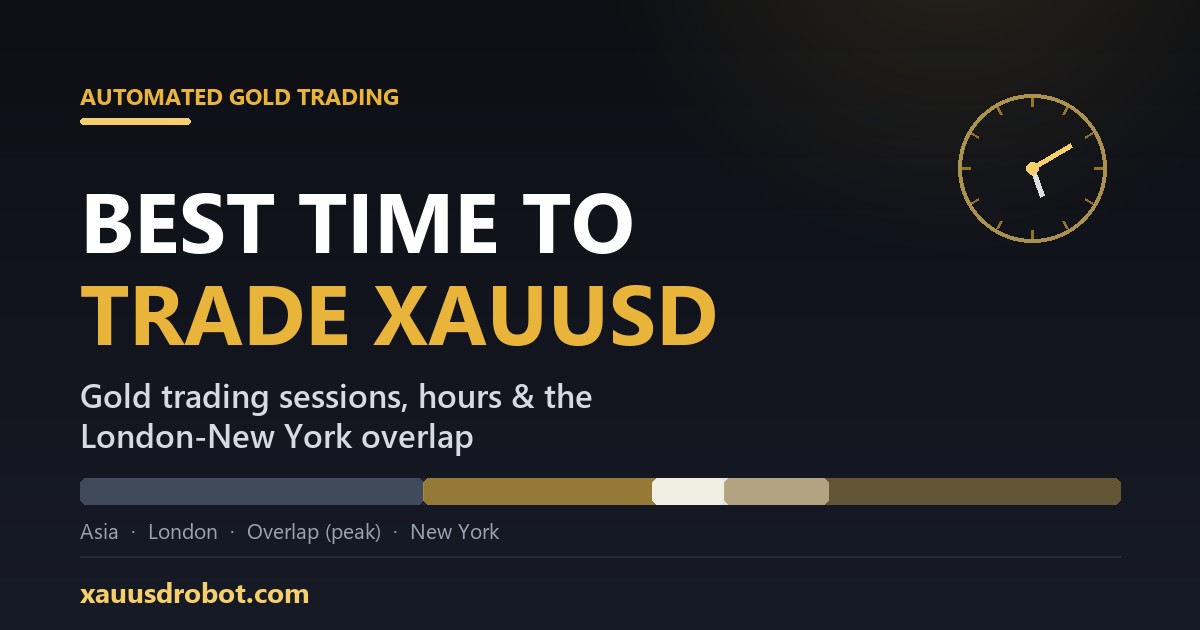
TL;DR The best time to trade XAUUSD is the London–New York overlap, roughly 13:00–17:00 GMT, when both major sessions are open. That's when gold has the most liquidity, the tightest spreads and its largest, cleanest moves. The Asian session is the quietest, and spreads are widest around the daily rollover (~21:00–22:00 GMT).
Gold market hours: when it's actually open
XAU/USD trades almost 24 hours a day, five days a week — from Sunday evening to Friday evening — with a short daily maintenance break around the rollover. But "open" and "worth trading" are two very different things. Gold spends large parts of the day drifting in thin liquidity, and only a few hours where it genuinely moves.
One important caveat: your platform shows broker server time, which is often GMT+2 or GMT+3, not your local time. All times below are in GMT/UTC — convert them to your broker's clock before setting anything.
The four trading sessions (GMT)
| Session | Hours (GMT) | Gold behaviour |
|---|---|---|
| Sydney | 21:00 – 06:00 | Thin, small ranges, wider spreads |
| Tokyo (Asian) | 00:00 – 09:00 | Quiet; often ranges, occasional China-driven moves |
| London | 08:00 – 17:00 | Volume picks up sharply; real trends begin |
| New York | 13:00 – 22:00 | US data hits; biggest daily moves |
Note: these shift by an hour during daylight saving (BST/EDT) — London and New York both move, so the overlap tracks with them.
The London–New York overlap: gold's prime time
⭐ 13:00 – 17:00 GMT
Both London and New York are open at once. This is where the majority of gold's daily range is produced — highest liquidity, tightest spreads, strongest follow-through on breakouts.
Why it matters so much for XAU/USD specifically: gold is priced in US dollars and reacts to US data, while London is the world's largest physical gold trading hub. When both are active, order flow from both sides hits the market at the same time. That's why a move that starts at 13:30 GMT often runs, while the same setup at 03:00 GMT fizzles out.
Practical takeaway: if you can only watch the market for a few hours a day, make it this window.
The worst times to trade gold
- Daily rollover (~21:00–22:00 GMT). Liquidity providers step back, spreads widen sharply, and swap is applied. A stop that would never be hit in normal conditions can get taken out by the spread alone.
- Sunday open. Gaps and wide spreads while liquidity returns.
- Late Asian session. Thin ranges — you pay the spread for very little movement.
- Friday close. Liquidity thins and anything left open carries weekend gap risk.
Spread reality: gold's spread is not constant. It can be a fraction of a point during the overlap and several times wider at rollover. If your strategy takes small profits, trading in the wrong hours quietly destroys the edge — which is why the broker you choose matters as much as the hour.
The news times that really move XAUUSD
Beyond sessions, a handful of scheduled releases dominate gold's biggest candles — nearly all of them US data landing inside the New York session:
- Non-Farm Payrolls (NFP) — first Friday of the month, 12:30/13:30 GMT
- CPI inflation — monthly, 12:30/13:30 GMT
- FOMC rate decision & press conference — 18:00/19:00 GMT on decision days
These produce spikes, spread blowouts and slippage in seconds. Most disciplined traders and robots simply stand aside. We covered this in depth in trading gold during news.
What this means if you run a gold EA
An expert advisor on a VPS can trade 24/5 — but "can" isn't "should". The hours above translate into three concrete settings worth checking on any gold robot:
- Session filter. Restrict trading to high-liquidity hours (London + New York) rather than letting it trade thin Asian ranges.
- Rollover avoidance. Block new entries around 21:00–22:00 GMT where spreads spike.
- News filter. Pause around NFP, CPI and FOMC instead of trading into the spike.
This matters most for fast strategies — a scalping bot that ignores session and rollover conditions will bleed on costs no matter how good its entry logic is. Slower, trend-following systems are more forgiving, but still benefit. For the wider picture on how these robots work, see our complete guide to XAUUSD robots, and the different approaches in gold EA strategy types.
Our free gold EA is trend-following and non-martingale, with a fixed stop-loss on every trade — and you can run it on a VPS so it's active through the London–New York window without you watching.
Get the Free Gold EA →Questions we get
What is the best time to trade XAUUSD?
The London–New York overlap, roughly 13:00–17:00 GMT. Both major sessions are open, liquidity and volatility peak, and spreads are usually tightest.
When is gold most volatile?
During London and New York hours — especially their overlap — and around high-impact US data like NFP, CPI and FOMC. The Asian session is much quieter.
What time does the gold market open and close?
Gold trades nearly 24 hours from Sunday evening to Friday evening, with a short daily break at rollover. Exact times depend on your broker's server time.
Is the Asian session good for trading gold?
It's the quietest period, with smaller ranges and wider spreads. Range strategies can suit it; breakout and trend strategies usually do better in London/New York.
When are XAUUSD spreads the widest?
Around the daily rollover (~21:00–22:00 GMT), at the Sunday open, and in thin late-Asian hours. Tightest during London and New York.
Should I trade gold during news releases?
NFP, CPI and FOMC cause sharp spikes, wider spreads and slippage. Many traders and EAs use a news filter to pause rather than trade the spike.
Can a gold EA trade 24 hours a day?
Technically yes on a VPS, but it shouldn't trade every hour. Session filters and rollover avoidance protect results from thin-liquidity conditions.
Is Friday a good day to trade gold?
Early Friday can be active around US data, but liquidity thins into the close and open positions carry weekend gap risk.
The verdict
Gold may be open almost around the clock, but it only really trades for a few hours a day. The London–New York overlap (13:00–17:00 GMT) is where the liquidity, the tight spreads and the genuine moves live; the rollover window and thin Asian hours are where edges quietly die to the spread. Whether you trade manually or run a robot, matching your activity to those hours — and standing aside around major news — is one of the simplest, cheapest improvements you can make.
Questions about session settings?
Ask us about session filters, VPS setup, or the free gold EA.
💬 Talk to Us on TelegramMore from the lab
- → How to Trade Gold (XAUUSD): Beginner's Guide
- → What Moves the Gold Price? XAUUSD Drivers Explained
- → Trading Gold During News: NFP, FOMC & CPI
- → XAUUSD Scalping Bot: Free Gold Scalper EA
- → Best Brokers for XAUUSD / Gold EA Trading
- → XAUUSD Robot: The Complete 2026 Guide
- → Gold EA Strategy Types Explained
- → Server Time vs GMT: An EA's Trading Hours
Risk & affiliate disclosure: Educational content only, not financial advice. Session and spread behaviour varies by broker — always check your own platform's server time and contract specification. Trading gold (XAUUSD) carries substantial risk of loss and automated trading does not remove it. We may earn a commission if you open an account through partner links, at no extra cost to you — this funds the free EA. See our Affiliate Disclosure.