Copy Trading vs Expert Advisors: Two Different Bets
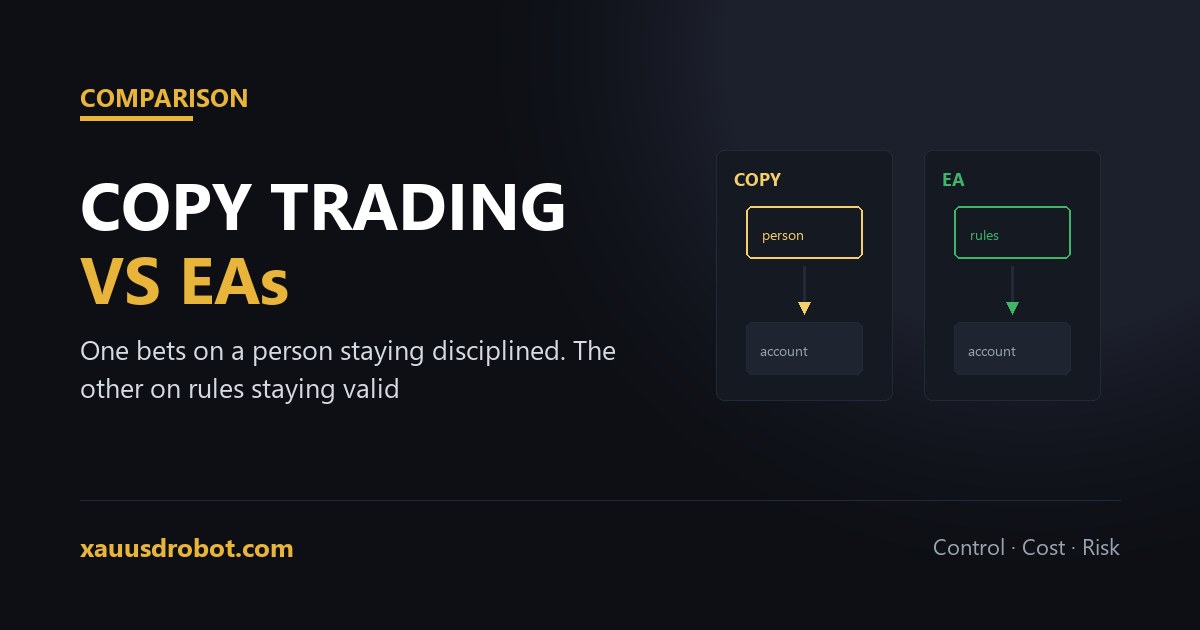
TL;DR Both remove you from the decision, but they are not the same bet. Copy trading mirrors a human's live trades into your account — you are betting a specific person stays disciplined, and their risk appetite becomes yours. An Expert Advisor runs a fixed ruleset on your own terminal — you are betting those rules stay valid, but you control the settings and can inspect them. Copy trading typically costs a performance fee or spread markup; EAs are usually one-off or free with a broker. Neither reduces risk; both change who decides.
What each one actually is
Under the marketing they are mechanically different in a way that determines everything else.
Copy trading connects your account to another trader's. When they open a position, a proportional position opens in your account, usually within a second or two. The decisions are being made live by a person you cannot see, using judgement you cannot inspect, for reasons you will not be told.
An Expert Advisor is a program running on your own MetaTrader terminal. It evaluates conditions and places orders according to rules that were fixed before you installed it. Nobody is deciding anything in real time; the decision was made when the code was written, and you can read the settings.
The distinction is not automation versus human — both are automated in delivery. It is live judgement versus frozen judgement.
The comparison that matters
| Copy trading | Expert Advisor | |
|---|---|---|
| Who decides | Another trader, live | Rules fixed in advance |
| Can you inspect the logic | No — only the resulting trades | Partly: settings always, logic sometimes |
| Adapts to new conditions | Yes, if the person adapts well | No, unless a filter covers it |
| Runs when your PC is off | Yes, server-side | Only with a VPS |
| Typical cost | Performance fee, spread markup, or both | One-off purchase, or free via broker |
| Main risk | The person changes behaviour | The market changes, the rules do not |
| Control you retain | Position size multiplier; stop copying | All risk settings, plus which sessions |
The hidden risk in copy trading
The visible risk is that the trader loses money. The subtler one is that you are copying their psychology, not just their trades — and psychology changes.
A provider trading a small personal account behaves differently once thousands are following and performance fees are meaningful. Some become conservative to protect a ranking. Others take larger risk to stay visible on a leaderboard. Neither shift is announced, and both arrive in your account automatically.
There is a selection effect too. Leaderboards rank by recent return, which favours whoever took the most risk and got away with it. The trader at the top of a three-month table is frequently the one whose luck has not run out yet, which is precisely when new followers arrive.
Finally, most platforms let you scale position size but not risk logic. If the provider adds to a losing position, your account does too, at whatever multiple you set. Reading their equity drawdown rather than balance drawdown is the only way to see that behaviour before it happens to you.
The hidden risk in an EA
The EA's weakness is the mirror image: it never changes its mind. A ruleset derived from one market regime keeps executing faithfully into a different one, with no capacity to notice the difference. A breakout system built through a trending period will keep buying breakouts through a year of chop, correctly and unprofitably.
There is also a stack of dependencies a copy service handles for you: the terminal must stay running, the connection must hold, and the platform must not be updated mid-position — which is why anyone running an EA seriously ends up on a VPS.
Against that, you gain something significant: the rules are fixed, so they can be tested before you commit money. You cannot backtest a person.
What each actually costs
Copy trading is rarely free even when advertised as such. The common structures are a performance fee on profits, a widened spread on every copied trade, or a monthly subscription. The spread markup is the one to watch: it is charged whether or not you profit, and it is invisible unless you compare fills against the raw feed.
EAs are typically a one-off purchase, a rental, or free through a broker partnership — which is how ours are distributed, with the broker commission funding the software. In every model, ask what is being charged, when, and whether it is charged on losses too.
Which one suits you
Copy trading fits someone with no interest in mechanics who wants exposure to a strategy, accepts they cannot inspect it, and will actually check the provider's risk behaviour rather than the return column.
An EA fits someone who wants to see and set the rules, is willing to test before funding, and can run a VPS. It also fits anyone who wants to learn: watching a system execute a defined strategy through a losing streak teaches more about trading than any amount of reading.
What neither does is remove risk. Both change who is deciding — not whether the decision can be wrong. The account, and the loss, remain entirely yours.
Questions we get
Is copy trading safer than using an EA?
Neither. One risks a person changing behaviour, the other risks fixed rules meeting a changed market. Risk settings decide safety, not the format.
Can I use copy trading and an EA at the same time?
Yes, but keep them on separate accounts. Two systems on one account create margin and drawdown conflicts.
Do copy trading platforms charge fees?
Usually — a performance fee, a spread markup, or a subscription. The spread markup is the easiest to miss and applies to losses too.
Why do copy trading leaderboards change so much?
They rank by recent return, which favours high risk that has not yet backfired. Judge by longer, risk-adjusted records instead.
Do I need a VPS for copy trading?
No — copy services run server-side. EAs execute on your own terminal, so they need a VPS to stay online.
Which is better for a beginner?
An EA on demo teaches more, since the rules and risk settings are visible. Copy trading hides the part worth learning.
The verdict
Copy trading is a bet on a person staying disciplined; an Expert Advisor is a bet on a ruleset staying relevant. Both are real bets with real failure modes, and choosing between them is mostly a question of whether you would rather have adaptability you cannot inspect, or transparency that cannot adapt. Whichever you pick, the position size and the loss limit are still yours to set — and they will matter more than the choice itself.
Comparing a copy service against an EA?
Send us the provider's record and we will show you what to look at beyond the return column.
💬 Talk to Us on TelegramMore from the lab
Risk & affiliate disclosure: Educational content only, not financial advice. Trading gold (XAUUSD), forex and CFDs carries substantial risk of loss; a large majority of retail CFD accounts lose money. No results are guaranteed. We may earn a commission if you open an account through partner links, at no extra cost to you — this funds the free EA. See our Affiliate Disclosure.