How Do Trading Robots Work? The Honest Look Inside an EA
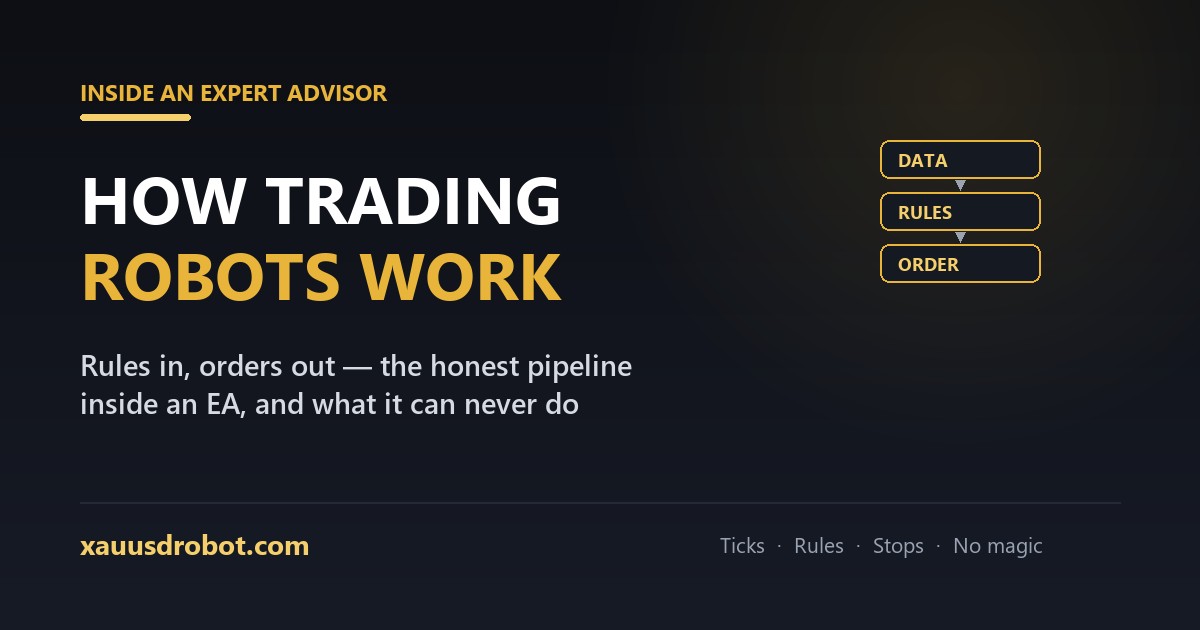
TL;DR a trading robot (Expert Advisor) is a program running on your MetaTrader platform that repeats one loop endlessly: read incoming price data → check it against written strategy rules → when conditions match, send an order to your broker with a stop-loss and calculated position size attached. That's the whole machine. It executes rules with perfect consistency 24/5 — and it cannot predict prices, remove market risk, or turn a bad strategy good.
The pipeline: tick to order
| Stage | What happens |
|---|---|
| 1. Data in | Every price change ("tick") on the chart wakes the EA — dozens of times a minute on gold |
| 2. Filters first | Is it a liquid session? Is news scheduled? Spread acceptable? If not — do nothing (the most underrated feature) |
| 3. Rules check | The coded strategy — e.g. trend direction via moving averages, momentum confirmation — evaluates exactly as written |
| 4. Risk module | Position size computed from account balance and stop distance (fixed-fractional risk), stop-loss and take-profit set |
| 5. Order out | Trade sent to the broker through the platform; then managed (trail, exit) by the same loop |
Notice what's absent: prediction. A robot never "knows" where gold is going — it recognizes conditions and responds by rule, the same reactive philosophy we covered in why nobody can predict gold.
Where robots live: MetaTrader and the VPS
Retail robots are almost all MQL programs on MT4/MT5 — the platform provides price data, chart access and the broker connection; the EA supplies decisions. Because the program only runs while the terminal does, serious users host it on a VPS: a small always-on server near the broker, giving 24/5 uptime and single-digit-millisecond execution. Setup is genuinely simple — file into the Experts folder, drag onto a chart, enable auto-trading (full setup guide).
What's actually inside the rules
Open an honest EA's logic and you'll find the same minimal stack a disciplined manual trader uses — trend definition, volatility-sized stops, session awareness — written as precise conditions instead of chart-watching. The strategy type matters enormously: trend-following and breakout logic carry defined risk per trade, while martingale/grid engines multiply into losers — the difference between bounded and unbounded risk explained in strategy types.
What robots genuinely do better than humans
- Consistency: the 500th trade executes exactly like the 1st — no revenge trades, no hesitation, no 3am fatigue.
- Discipline enforcement: the stop-loss is code, not a promise to yourself.
- Coverage: gold trades nearly 24/5; a robot on a VPS actually watches all of it.
- Testability: rules can be backtested against years of data before a cent goes live.
What no robot can do (the honest half)
- Predict prices — it reacts to conditions; the future stays unwritten.
- Remove market risk — a stop caps each loss; losses still happen in streaks.
- Fix a bad strategy — automation makes execution perfect, including perfectly executing a losing system.
- Guarantee returns — anyone claiming otherwise failed the verification framework at step one.
About "AI robot" marketing: genuine algorithmic analysis — pattern conditions, adaptive filters — is real and useful for execution. "AI that predicts the market" is the same impossible claim in a newer costume. Judge any robot by its verified record and explainable rules, never its buzzwords — here's how.
How our robot runs this pipeline
The free XAUUSD Robot is a working example of everything above: trend-following rules on gold, session + news filters deciding when it's allowed to act, fixed-fractional sizing with a hard stop on every order, no martingale anywhere in the loop — running 24/5 on MT4/MT5. The pipeline is explainable because honest pipelines always are.
See it run: free via partner-broker signup — test the whole machine on demo first, exactly as we'd tell you to test anyone's robot.
Get the Free Gold Robot →Questions we get
How does a trading robot work?
A loop: price in → filters → rules → sized order with stop out. Consistency, not prediction.
Do trading robots actually make money?
Some verified ones do, with losing periods — the strategy, not the automation, decides.
Can a trading robot predict the market?
No — they react to conditions by rule. Prediction claims are marketing.
What is an EA in trading?
MetaTrader's name for a trading robot — an MQL program that trades its coded rules.
Do I need a VPS to run a trading robot?
Standard for serious use — 24/5 uptime and low latency. A home PC works if always on.
Are trading robots safe to use?
The mechanism is safe; the strategy inside decides. Stops + verification + demo-first = the safe end.
The verdict
A trading robot is gloriously unmagical: a loop that reads prices, applies written rules, and sends risk-managed orders — thousands of times, identically, without ego. That boring consistency is the entire product, and it's genuinely valuable when the rules inside deserve it. Understand the pipeline and the marketing fog clears instantly: verify the record, read the rules, test on demo — and let the machine do what machines do best.
Want to see inside a real EA's logic?
Ask us how any part of our robot works — we explain it plainly.
💬 Talk to Us on TelegramMore from the lab
Risk & affiliate disclosure: Educational content only, not financial advice. Trading gold (XAUUSD), forex and CFDs carries substantial risk of loss; a large majority of retail CFD accounts lose money. No results are guaranteed. We may earn a commission if you open an account through partner links, at no extra cost to you — this funds the free EA. See our Affiliate Disclosure.